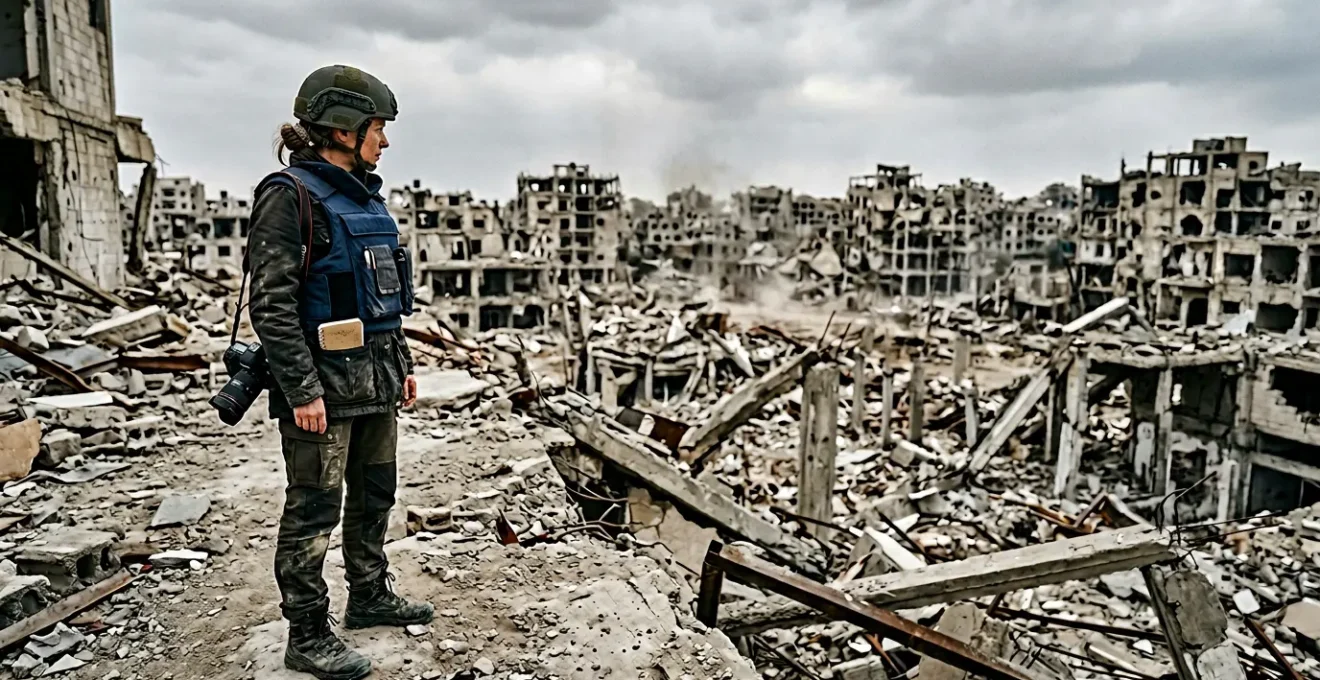
Reporting on complex conflicts is not about finding an elusive ‘objective’ truth, but about mastering disciplined frameworks to manage asymmetric information and operational friction.
- Effective coverage requires shifting from journalistic ideals to field-tested protocols for verification, source interaction, and personal security.
- The greatest threat is not just physical danger, but the velocity of disinformation; the right response is disciplined delay and rigorous, multi-layered verification.
Recommendation: Internalize these protocols not as a checklist, but as a mental framework to navigate the ‘fog of war’ and report with ethical clarity and accuracy.
The first casualty of war is truth, but the first challenge for a correspondent is the deluge. A torrent of claims, counter-claims, graphic images, and desperate pleas floods your channels. The conventional wisdom for journalists—be objective, protect your sources, fact-check everything—feels hollow against the sheer velocity and violence of a modern crisis. You are asked to build a coherent narrative from the shrapnel of a collapsing reality, often for an audience thousands of miles away, while navigating both physical danger and a minefield of disinformation designed to weaponize your platform.
This is not a guide about the ideals of journalism. It assumes you know them. This is a guide about what works under fire. It’s about the operational discipline required when the internet is down, the roads are blocked, every source has an agenda, and your own trauma is a factor. Covering complex global events without oversimplifying isn’t a matter of good intentions; it’s a matter of mastering a set of counter-intuitive, rigorous protocols. It’s about building a framework that allows you to separate signal from noise, protect yourself and your sources, and tell a story that is not just factually correct, but ethically sound.
This article lays out field-tested strategies for every stage of the reporting process. From the gear that actually saves lives to the art of interviewing a trauma victim, we will explore the practical frameworks that allow you to maintain your ethical and journalistic bearing in the most challenging environments on Earth.
Table of Contents: A Framework for Reporting in Crisis Zones
- What to Pack for a Conflict Zone: The Essentials That Save Lives
- The Translation Trap: How to Avoid Misinterpreting Local Nuances?
- How to Interview Victims of Trauma Without Causing More Harm?
- Fog of War: How to Verify Claims When You Can’t Access the Frontline?
- Speed vs. Truth: Why You Should Wait 10 Minutes Before Retweeting a Blast?
- How to Access and Read Satellite Imagery for Free?
- How to Shoot Stable Footage Without a Heavy Tripod in the Field?
- How to Master Fact-Checking Fundamentals Before Publishing Your First Story?
What to Pack for a Conflict Zone: The Essentials That Save Lives
Your assignment is confirmed. The first tangible step is packing. This is not about comfort; it’s about survival and operational effectiveness. While a flak jacket and helmet are non-negotiable, the gear that truly saves you is often less obvious. The dangers are not just physical. In an era where being a journalist is increasingly perilous, your digital footprint is as vulnerable as your person. The reality is stark: an investigation by the Committee to Protect Journalists found that 43 freelance journalists were killed in 2024, a number that underscores the lethal risks involved.
Your “go-bag” must be a dual-purpose toolkit for both physical and digital defense. Think in layers. Your outermost layer is your physical protection and basic sustenance. But your most critical inner layer is your digital security kit. This is your fortress. It’s what allows you to communicate securely, store data safely, and protect your sources when you are compromised. Consider it your modern-day armor; its components are as vital as any ballistic plate.
This means assembling a dedicated Digital Security Go-Bag. This isn’t just software; it’s a pre-configured physical kit you can grab and trust. Essential items include:
- A pre-configured encrypted USB drive with a secure operating system like Tails.
- Offline map applications and cached communication protocols that work without a network.
- An encrypted password manager with emergency contacts and critical information.
- Redundant digital copies of your credentials, insurance, and proof-of-life documents stored on separate, encrypted devices.
- Pre-paid VPN configurations for multiple providers, allowing you to switch if one is blocked or compromised.
This preparation is your first line of defense. It acknowledges that in modern conflict, the battle for information begins long before you reach the frontline, and your equipment is the foundation of your ability to report safely and effectively.
The Translation Trap: How to Avoid Misinterpreting Local Nuances?
On the ground, your most important relationship is often with your fixer and translator. They are your key to a world you don’t understand, your guide through cultural and linguistic minefields. But this reliance is also a great vulnerability. A mistranslated word or a missed cultural cue can not only derail your story but can also endanger lives. The goal is not word-for-word translation, but the accurate conveyance of meaning, context, and intent—a much harder task.
The best local journalists are not just translators; they are cultural interpreters. A powerful case study on Palestinian journalists in Gaza by AUC faculty highlights this role. It documents how 18 local reporters navigate immense pressure, serving as vital bridges who explain complex social dynamics and untranslatable concepts to the world. They are practicing journalism while living the crisis, a dual role that provides unparalleled depth but also requires careful consideration of potential biases.
For a foreign correspondent, this means you cannot afford to be a passive recipient of information. You must build a system of active verification for translations. This involves treating translated information with the same skepticism you would any other source. There are several methods to build this verification layer into your workflow, each with its own strengths and weaknesses.
| Method | Advantages | Limitations | Best Use Case |
|---|---|---|---|
| Back-Translation | Reveals interpretation gaps | Time-intensive | Critical interviews |
| Multiple Fixers | Cross-verification possible | Higher cost | Sensitive testimonies |
| Cultural Advisor | Context beyond words | Finding qualified experts | Complex social dynamics |
| Local Journalist Partnership | Deep cultural knowledge | Potential bias | Long-form investigations |
Adopting a multi-layered approach is crucial. For a critical interview, you might use your primary fixer, then later have a separate translator perform a “back-translation” (translating the English transcript back into the original language) to spot discrepancies. This isn’t about mistrusting your fixer; it’s about professional discipline and ensuring the integrity of the voices you are trying to amplify.
How to Interview Victims of Trauma Without Causing More Harm?
You find a survivor. They have a story that the world needs to hear. Your journalistic instinct is to get the story, to ask “What happened?” But for a victim of recent trauma, that question can be a violent act, forcing them to relive an experience they haven’t begun to process. The ethical tightrope you must walk is precarious: your job is to bear witness, but your primary human responsibility is to do no harm.
Journalists operating in their own communities often face an impossible conflict, forced to report on tragedies affecting their own friends and neighbors. As Palestinian journalist Haneen Harara described in research on Gaza journalists, the professional imperative can suppress the personal response:
There was no time to feel sad or shocked. There were people we needed to report about in the news, live reports
– Haneen Harara, AUC Research on Gaza Journalists
This highlights the immense psychological burden. As an outside correspondent, your role is different, but the need for a structured, ethical approach is even greater. The key is to shift the dynamic from an extractive one (“I need your story”) to a collaborative one (“Help me understand what you want the world to know”). This requires implementing an “Agency-First” interview protocol. This framework is designed to return control to the survivor.
- Begin with agency-giving questions: Instead of “What happened?”, start with “What do you want people to know?” or “What is the most important thing for the world to understand right now?”
- Establish a clear contract: Be transparent about where the story will be published, how their identity will be handled, and what the post-interview process looks like. Allow them to set boundaries on topics and timing.
- Give them control over the narrative: Let the interviewee review their quotes or the section of the story that pertains to them before publication. This builds trust and ensures accuracy.
- Provide a transparent timeline: Explain the publication process and when they can expect to see the story. The waiting period can be a source of immense anxiety.
- Schedule a post-interview debrief: Where possible, a brief check-in 48 hours later can be a powerful gesture, reinforcing that you see them as a person, not just a source.
This is not about being “soft.” It is about a disciplined, ethical practice that leads to more accurate, powerful, and responsible journalism. A story obtained by re-traumatizing a victim is a story built on a foundation of harm.
Fog of War: How to Verify Claims When You Can’t Access the Frontline?
The frontline is inaccessible. A village has allegedly been shelled, and both sides are circulating horrific, contradictory videos. Your desk is demanding a story, but you are hundreds of miles away, staring at a screen. This is the reality of modern conflict reporting. The “fog of war” is no longer just a lack of information; it’s a tsunami of weaponized, fragmented, and often fabricated data. The risks are not theoretical; UNESCO monitoring reveals that over 50% of journalist killings in 2023 occurred in crisis zones where access and verification are most difficult.
In this environment, your most valuable asset is a remote verification network. You cannot be an expert on everything, but you can build a distributed network of trusted nodes—diaspora experts, academics, open-source intelligence (OSINT) analysts, and other local sources who can help you piece together the puzzle. This model proved highly effective during the Ukraine conflict, as detailed in an RSF case study. Journalists, unable to access occupied areas, established robust virtual networks to cross-reference claims.
Virtual Verification Networks in the Ukraine Conflict
In the wake of the full-scale invasion, journalists established remote verification networks that combined the expertise of diaspora communities, academics specializing in the region, and trusted local sources on the ground. Organizations like Reporters Without Borders (RSF) supported 129 Ukrainian media outlets with equipment and training, bolstering their capacity for this distributed fact-checking. This approach allowed for the verification of military claims and reports of atrocities through multiple, independent channels, even when physical access was impossible, creating a resilient and more reliable flow of information.
This model moves beyond the lone-wolf correspondent to a more collaborative, network-based approach to truth-seeking. Your job shifts from being the sole eyewitness to being the lead investigator, directing and synthesizing the findings of your network. The core skill becomes knowing who to ask and how to weigh the information they provide based on their expertise and potential biases. It’s a slow, painstaking process, but it’s the only way to report with confidence when you can’t see the ground for yourself.
Speed vs. Truth: Why You Should Wait 10 Minutes Before Retweeting a Blast?
An explosion rocks a city you’re covering. Within seconds, your social media feed is a chaotic mosaic of grainy videos, conflicting reports of casualties, and furious accusations. The pressure to be first—to retweet, to share, to file a flash update—is immense. Your news desk is calling. Followers are demanding information. Resisting this urge is one of the hardest and most important disciplines in modern journalism.
In the digital age, speed is the enemy of truth. Disinformation actors rely on the chaos of a breaking event to inject their narratives, knowing that the initial, emotional story is the one that sticks, regardless of later corrections. The deadly cost of this dynamic is real, as the information environment directly impacts safety on the ground. UN data shows that of the 68 journalists killed in 2024, 60% were in conflict zones where rushed and inaccurate reporting can inflame tensions and create direct threats. Your first contribution in a crisis should not be to amplify the noise, but to create a pocket of silence and disciplined thought.
This is the purpose of the “10-Minute Verification Drill.” Before you share any piece of user-generated content from a breaking news event, stop. Take a deep breath. And for the next ten minutes, become a forensic investigator. This is not a passive wait; it’s an active, focused process. Your drill should include:
- Source Forensics: Check the account’s creation date and posting history. Is it a real person with a history, or a new account that only posts about the conflict?
- Media Forensics: Do a reverse image search on the profile picture and any attached media. Has this image appeared before in a different context?
- Network Analysis: Scan the replies and retweets. Is there evidence of coordinated messaging or bot-like activity?
- Cross-Referencing: Check your pre-vetted lists of established news agencies, local journalists, and official sources. Has anyone else confirmed the information?
- Linguistic Analysis: Look for awkward phrasing or unusual syntax that might suggest the use of automated translation, a common hallmark of state-sponsored disinformation campaigns.
These ten minutes of disciplined inaction can be the difference between responsible journalism and becoming an unwitting agent of propaganda. The story will still be there in ten minutes. Your credibility might not be.
How to Access and Read Satellite Imagery for Free?
When the ground is a black box, the sky can offer a window. Satellite imagery has become an indispensable tool for open-source intelligence (OSINT) and conflict reporting, allowing journalists to verify claims of destruction, track troop movements, and monitor humanitarian crises from afar. It is the ultimate “trust but verify” tool, providing a layer of empirical evidence that can cut through the noise of propaganda.
This is not a hypothetical tool for intelligence agencies; it’s a practical resource for newsrooms. A prime example is the use of satellite data to document the changing landscape in conflict zones. The Council on Foreign Relations reported on how journalists have leveraged this technology to great effect.
Satellite Verification of Gaza Infrastructure Damage
Throughout the 2024-2025 conflict, with ground access severely restricted, journalists and human rights organizations turned to publicly available satellite data from sources like Sentinel Hub. By correlating this imagery with eyewitness reports from the ground, they were able to independently document patterns of infrastructure destruction. Time-lapse analysis, as reported by outlets utilizing this data, revealed the expansion of refugee camps and significant changes to agricultural land, providing objective, verifiable evidence of the conflict’s impact on civilian life when other forms of reporting were impossible. This method became a cornerstone of accountability efforts during the crisis.
The power of this technology lies in its increasing accessibility. Several platforms offer high-quality, free-to-use satellite imagery that can be integrated into any journalist’s workflow. Understanding the strengths of each is key to using them effectively.
| Platform | Resolution | Update Frequency | Best For |
|---|---|---|---|
| Sentinel Hub | 10m | 5 days | Large area changes |
| NASA Worldview | 250m | Daily | Fire/smoke detection |
| Planet Labs (free tier) | 3-5m | Daily | Specific locations |
| Google Earth Engine | Variable | Historical archive | Before/after comparison |
Mastering these tools requires a new skill set—learning to “read” an image for tell-tale signs of change, understanding what resolution is needed for a specific task, and, most importantly, always correlating satellite data with other sources. An image without context is just data; an image paired with a ground report is evidence.
How to Shoot Stable Footage Without a Heavy Tripod in the Field?
You’re on the move. A protest is turning violent, or you’re following a humanitarian convoy. You need to capture steady, usable footage, but a heavy tripod is not just impractical, it’s a liability. It slows you down, marks you as a target, and is impossible to set up in a chaotic environment. In these situations, your body must become your stabilization system.
The goal is to minimize micro-movements and create a stable platform using your own anatomy and your immediate surroundings. This is a physical discipline, one that requires practice to master. It’s about creating points of contact and using your body’s mass to dampen the shakes and jitters that come with adrenaline and movement. A shaky, unusable shot is a missed story. Clean, stable footage, even if captured under duress, communicates professionalism and allows the viewer to focus on the content, not the camera work.
Instead of relying on gear, learn to apply the “Human Tripod” stabilization techniques. These are principles that can be applied with any camera, from a smartphone to a professional ENG rig:
- Create a Solid Core: Tuck your elbows in tight against your ribcage. This connects the camera to your core body mass, reducing arm shake and creating a much more stable base.
- Control Your Breathing: Your heartbeat is a major source of camera shake. Practice controlled breathing, similar to a sniper or an athlete. Get your shot framed, take a slow breath in, and then shoot on the long, slow exhale. The moment between heartbeats is your steadiest point.
- Find Three Points of Contact: A tripod is stable because it has three legs. Whenever possible, replicate this. Lean against a wall, a vehicle, or a tree. Plant your feet wide. If you’re kneeling, rest one elbow on your knee. The more points of contact you have with a stable object, the steadier your shot will be.
- Use the Strap: The camera strap isn’t just for carrying. Pull the camera away from your neck so the strap is taut. This creates an additional point of contact and a surprising amount of stabilization.
- Lean Into It: Use your body weight to your advantage. A slight forward lean, with your weight on the balls of your feet, can help dampen small movements and brace you against being jostled.
These techniques transform you from a passive operator into an active part of the stabilization system. They require no extra gear, only practice and discipline, making them the most reliable tools you have when you need to get the shot and get out.
Key Takeaways
- The core of modern conflict reporting is not just fact-finding but disciplined verification, using structured protocols to navigate a landscape of intentional disinformation.
- Ethical engagement with sources, especially trauma victims, is not a “soft skill” but a rigorous practice (the “Agency-First” model) that yields more accurate and responsible journalism.
- A correspondent’s most vital gear is increasingly digital; robust operational security and a mastery of open-source verification tools are as critical as a flak jacket.
How to Master Fact-Checking Fundamentals Before Publishing Your First Story?
Before you write a single word, before you even pitch your story, you must internalize the discipline of fact-checking. This is not the final step before publication; it is the foundational mindset of a credible journalist. In a conflict zone, a factual error is not just embarrassing—it can get people killed, including you. The imperative for rigorous verification is not just about upholding journalistic standards; it’s a matter of life and death, as RSF data showing 54 journalists killed in 2024, with 31 in conflict zones, tragically underscores.
The most effective approach is not reactive, but proactive. Instead of just debunking falsehoods as they appear, you must anticipate them. This is the principle of “pre-bunking.” It involves understanding the landscape of potential disinformation for your specific story and building an intellectual framework to resist it. It’s about mapping the propaganda narratives before they are deployed, inoculating yourself and your audience against them. This is an advanced form of fact-checking that moves from simple verification to strategic analysis.
Implementing a pre-bunking protocol is a systematic process. It’s a personal audit and a strategic plan that you create before you are under the pressure of a deadline or the emotional weight of a traumatic event. It’s about preparing your mind as rigorously as you prepare your gear.
Your Action Plan: The Pre-bunking Protocol for Conflict Reporting
- Map Narratives: Before coverage begins, identify and list the likely disinformation narratives that will emerge from all sides of the conflict.
- Identify Patterns: Research the historical propaganda patterns associated with the actors in the conflict. History is often the best guide to future tactics.
- Establish Baseline Facts: Before the crisis escalates, establish a set of baseline, undisputed facts from multiple, independent, and credible sources (e.g., UN reports, academic studies, census data).
- Create a Bias Inventory: Honestly assess and write down your own potential biases related to the story or region. Acknowledging them is the first step to mitigating them.
- Build a Pre-Verified Source Database: Create a private list of experts, analysts, and local journalists with specific tags for their areas of expertise, affiliations, and potential biases. This is your go-to network for quick verification.
This framework is your intellectual armor. It prepares you to navigate the information war with the same level of seriousness you would a physical threat. By mastering these fundamentals, you ensure that your first story—and every story after it—is built on a foundation of rock-solid, verifiable truth.
Adopting these disciplined frameworks is the only sustainable way to navigate the complexities of global events. It transforms the overwhelming chaos into a series of manageable challenges, allowing you to report with clarity, accuracy, and a firm ethical bearing. This is the craft of the modern correspondent.